
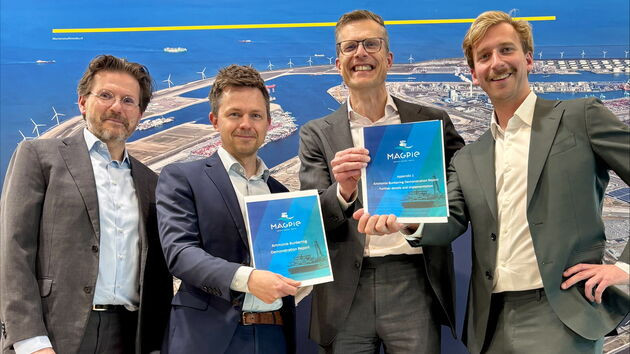
The Port of Rotterdam has successfully demonstrated that ship-to-ship ammonia bunkering can be performed safely within an active port environment. Conducted under the EU-funded MAGPIE project, the full-scale simulation carried out on 12 April 2025, confirmed that bunkering operations are safe when executed within a strong safety and regulatory framework.
The final findings have been consolidated into a comprehensive, publicly available report by the Mærsk Mc-Kinney Møller Center for Zero Carbon Shipping and project partners to provide practical guidance for global ports and industry stakeholders preparing for alternative fuels.
A key outcome of the project is the validation of the Port of Rotterdam’s safety framework for ammonia alongside the International Association of Ports and Harbours’ (IAPH) Port Readiness Tool. According to Bo Cerup-Simonsen, CEO of the Mærsk Mc-Kinney Møller Center for Zero Carbon Shipping, the project delivers practical learnings, validation sheets, and recommendations that can inform future global permitting and regulatory processes. Boudewijn Siemons, CEO of the Port of Rotterdam, noted that this pilot represents an important step in developing a complete value chain for alternative fuels, showing that innovation, safety, and scalability can go hand in hand.
The MAGPIE (sMArt Green Ports as Integrated Efficient multimodal hubs) project is a European initiative focused on developing, testing, and demonstrating solutions for sustainable and smart port logistics. By openly sharing these results, the involved partners aim to support the decarbonisation of port-related transport and accelerate the safe adoption of ammonia as a low-carbon marine fuel worldwide.